
|
One of the biggest obstacles some people face when they decide to install a waterless composting toilet in their household is gaining council approval, but it's rarely the composting toilet system that's the issue - it's far more likely to be the council's attitude to greywater systems. If you are not flushing toilets, you don't need a septic system. There is no blackwater, so you should be able to install a simple, inexpensive system to reuse or dispose of the greywater from your kitchen, laundry and bathroom. But some councils can make life difficult. To cut to the chase, homes with compost toilets are not very common, so council officers are often not familiar with greywater only systems and the regulations and guidelines that govern their approval. They lack the training needed to understand the basic principles and properly assess a system for approval, so they tend to err on the side of caution and decline the application. Even a site specific system designed by a qualified professional (geo-technical engineer) may not gain approval due to the council officer's lack of knowledge and fear of the unknown. To justify their objections, some council officers argue that kitchen wastewater is deemed 'blackwater' and therefore requires extra treatment. That's not exactly true. AS NZS 1547-2012 defines greywater as “The domestic wastes from a bath, shower, basin, laundry, and kitchen, but excluding toilet and urinal wastes.” Many of the regulations, guidelines, codes of practice, etc that council officers reference are complex and ambiguous, which just adds to the confusion. What should be a fairly simple task becomes an excercise in regulatory gymnastics. Simple greywater systems can be approved by your local council, but plotting a path through the current regulatory maze requires extraordinary level of referencing and cross-referencing, which most council officers simply don't have time for. VIROtech has been working with stakeholders behind the scenes to address this issue by advocating for a training program to be rolled out to provide council officers with the knowledge they need to properly assess system applications. The basic principles in dealing with greywater are:
Before I go any further, it is important to reiterate that greywater systems are very site specific. Or more accurately, simple greywater systems are very site specific. There are some off-the-shelf 'accredited' one-size-fits-all greywater systems available on the market, but these tend to be way more complex and expensive the most households need. Your greywater system must be designed to suit your specific household, soil type, climate and proximity to water courses, but if you have a composting toilet it could be as simple as a grease trap and some perforated pipe buried 100mm below the surface. If your block is suitable, the greywater can be used to irrigate trees and shrubs, but we don't advise using it on your vegetable garden. Above ground irrigation systems (drippers, sprinklers, etc) are generally not approved by local councils without tertiary level treatment using complicated and expensive equipment. The diagram below shows a typical system design for a household with waterless composting toilets using standard plumbing fittings, but is only appropriate if the block meets certain criteria regarding soils, slope, water courses, etc. Most of the system can be built using commonly available plumbing materials. https://www.virotech.com.au/greywater.html 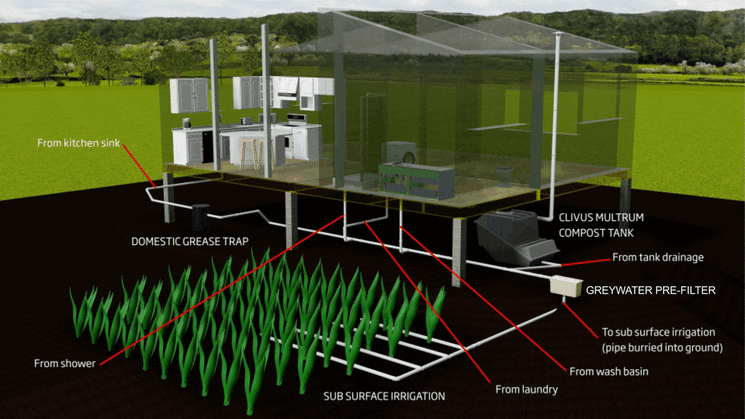 Application
Your on-site sewerage management systems (OSMS) application will typically need to be accompanied by:
The area of land required to disperse the effluent – the effluent disposal area (EDA) or leach field - will be determined by site characteristics described in the LCA using a ‘water balance’ calculation –a ‘water in/water out’ calculation based on factors such as the volume of effluent, soil porosity, slope, vegetation, and local rainfall patterns. The location of the EDA will be determined by factors such as soil types, slope and proximity to dams, water courses and boundaries. Key Points OSMS are site specific and there are numerous factors at play in determining the appropriate size and design of your OSMS.
DOWNLOAD the FREE VIROtech Green Greywater Guide HERE
1 Comment
Allan Mesilane
8/1/2024 11:40:10 am
I am looking for a grey water irrigation solution for my property in Central NSW. We have septic which takes car of the black water. Leave a Reply. |
AuthorGrant Webster ArchivesCategories |
 RSS Feed